PCOS (Now PMOS) and Menopause: Why Your Metabolic Health Needs a Lifelong Plan
- by Christiane Matey
- Anti-Aging, Blog, Healthy Living

An integrative dietitian’s guide to PCOS/PMOS after menopause, why metabolic health deserves attention at every life stage, and the food, movement, and lab-check habits that help keep blood sugar and hormones steady.
You’ve spent years learning the language of PCOS. The frustrating irregular cycles, stubborn weight, cravings with their own agenda, and lab results that never quite explain how you feel. Maybe you finally got things under control. Then menopause arrives, and a quiet assumption settles in: the hard part must be over, right?
Here’s the plot twist. For many women, it isn’t. A growing body of research suggests PCOS doesn’t retire when your periods end. It changes shape, and your metabolic health needs a plan that evolves with it.
At MINT Nutrition, we help women across the Mooresville area untangle exactly this. Below, we’ll walk through what the science says, what it means for your plate, and how to get support.
PCOS Has a New Name (and It Finally Makes Sense)
In 2026, an international consensus process published in The Lancet renamed polycystic ovary syndrome to polyendocrine metabolic ovarian syndrome (PMOS). The process drew on 56 academic, clinical, and patient organizations and more than 14,000 survey responses. The authors argue that the old name was inaccurate because it implies ovarian cysts. Plus, it hides the hormonal and metabolic side of the condition and contributes to delayed diagnosis, fragmented care, and stigma.
The paper estimates that the condition affects about one in eight women and notes that a transition period is underway. That means you’ll see both terms for a while. We’ll use PCOS/PMOS here so you can follow along no matter which term your provider uses.
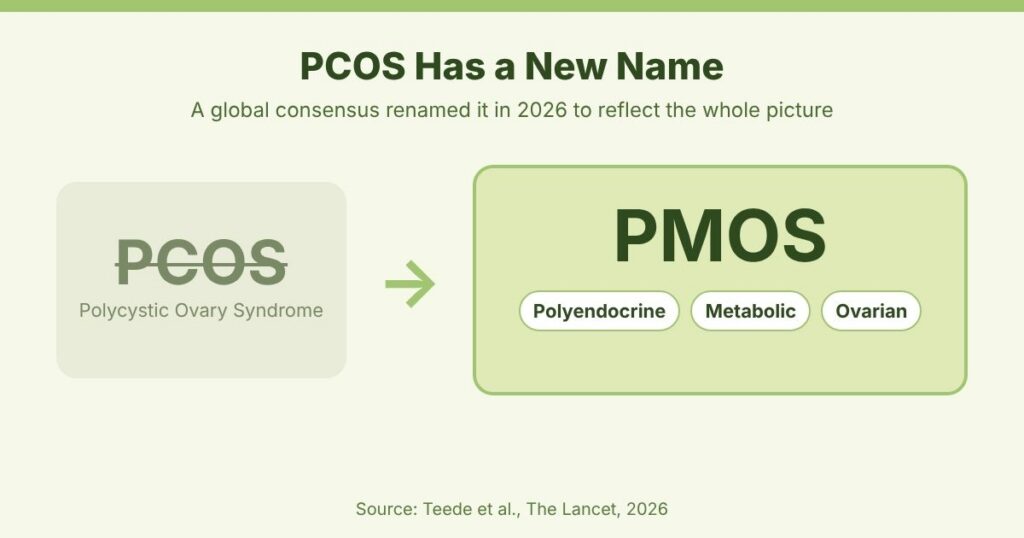
The new name matters for a practical reason. “Polycystic ovary syndrome” sounds like a reproductive issue that wraps up when fertility does. “Metabolic” says the quiet part out loud: this is a whole-body condition, and it doesn’t come with an expiration date.
What Happens to PCOS/PMOS After Menopause?
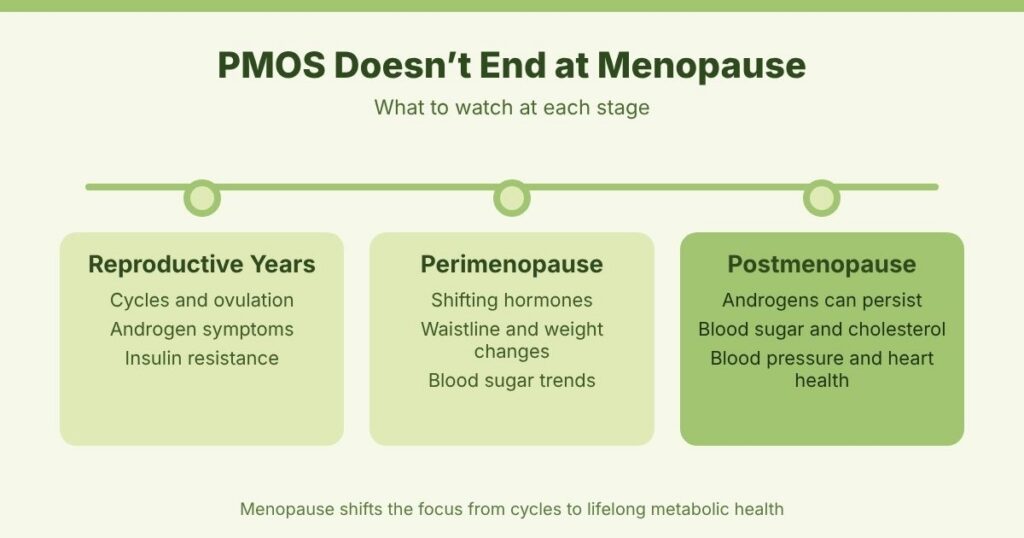
A recent A4M article by Christine Slattery makes the case that menopause changes how PCOS/PMOS should be monitored rather than ending it. The research points in the same direction, with some important fine print.
Hormones Don’t Simply Switch Off
A 2023 systematic review and meta-analysis in Human Reproduction Update compared women with and without PCOS during and after the menopausal transition. Women with PCOS had higher total testosterone, free androgen index, and androstenedione, along with lower sex hormone-binding globulin.
In the two postmenopausal studies that matched women by BMI, androgens remained higher in the PCOS group. That suggests the hormone pattern isn’t only about body weight.
Blood Sugar, Cholesterol, and Blood Pressure Take Center Stage
The same review found higher fasting glucose, fasting insulin, and insulin resistance (measured as HOMA-IR) in women with PCOS, along with roughly three times the odds of diabetes. HDL (“good”) cholesterol was lower, triglycerides were higher, and hypertension was more common. Heart attacks and strokes were also more common, although overall cardiovascular disease rates didn’t differ significantly between groups.
The A4M article adds visceral fat, fatty liver disease (MASLD), and chronic low-grade inflammation to the list of concerns that can linger in aging women with a PCOS/PMOS history.
Now the honest part. The review’s authors rated the overall evidence as low quality, with a lot of variation between studies. So this is a call for closer attention, not a prediction for any one woman. Your history is a reason to look, not a reason to panic.
Nutrition Strategies for Lifelong Metabolic Health
The good news is that food is one of the most flexible tools you have. Here’s what the evidence supports and how we put it into practice.
Choose a Pattern You Can Actually Keep
The 2023 International Evidence-based Guideline for PCOS found no single diet composition that outperformed the others. It recommends sustainable healthy eating tailored to your preferences and goals, and it cautions against overly restrictive or nutritionally unbalanced plans. It also notes that lifestyle changes support metabolic health even without weight loss.
That said, one pattern keeps rising to the top. A 2026 narrative review in Frontiers in Endocrinology reported that the Mediterranean diet had the strongest overall support among the approaches studied, with benefits for insulin sensitivity, lipids, and androgen levels. The author is upfront that the trials are short and small, so think of it as a promising framework rather than a guarantee.
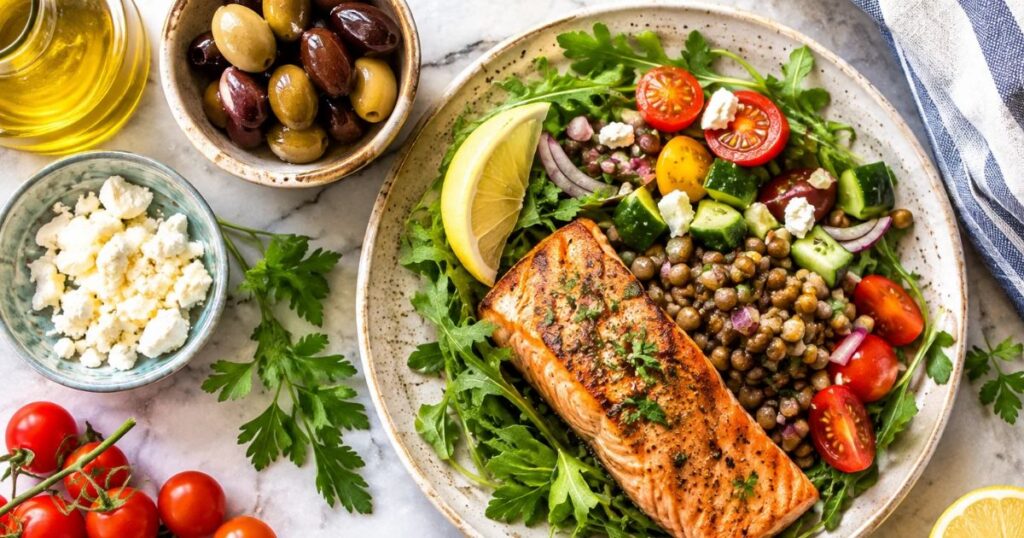
In real life, that means olive oil, fish, beans, colorful vegetables, nuts, and whole grains. No tiny portions of sadness required.
Build Plates That Keep Blood Sugar Steady
Since insulin resistance sits at the center of PCOS/PMOS, how you build a meal matters. You don’t need a spreadsheet or a food scale. A few simple habits go a long way:
- Anchor meals with protein, such as eggs, Greek yogurt, fish, poultry, tofu, or lentils.
- Add fiber-rich carbohydrates like beans, berries, oats, vegetables, and intact whole grains.
- Include healthy fats, such as avocado, nuts, olive oil, and fatty fish.
- Pair carbohydrates with protein and fat instead of eating them solo.
- Save sugary drinks and refined snacks for “sometimes” rather than “default.”
Nothing’s off limits. Strict food rules tend to backfire, and the guideline specifically steers away from them.
Protect Your Muscle
Muscle is one of the main places your body uses blood sugar, and it gets harder to hold onto as we age. The guideline recommends at least 150 to 300 minutes of moderate activity per week for adults, plus muscle-strengthening on two non-consecutive days. For modest weight loss or preventing regain, it suggests at least 250 minutes. It also reminds us that any movement beats none, and that no single type of exercise is best.
Protein plays a supporting role here. We tailor protein targets to your labs, medications, and goals, and our autophagy and aging post digs into protein timing and muscle preservation.

Feed Your Gut
The 2026 Frontiers review also describes a proposed link between gut health and PCOS. The idea is that an imbalanced gut microbiome may increase intestinal permeability and inflammation, which can worsen insulin resistance and androgen excess. It also reports that diets rich in fiber and plant variety are associated with greater microbial diversity. This area is still developing, so we treat it as a useful direction rather than settled science.
In practice, that means aiming for variety. Different colors, different plants, and fermented foods like yogurt, kefir, or sauerkraut if you tolerate them. If bloating or digestive issues are part of your story, our gut health services can help you sort out what’s going on first.

Supplements: Promising, Not Magic
The supplement aisle has plenty of opinions. The research is more cautious.
Inositol
A 2024 meta-analysis in the Journal of Clinical Endocrinology and Metabolism, done to inform the guideline update, pooled 30 trials involving 2,230 women. Inositol may help some metabolic measures, and D-chiro-inositol may help ovulation. Overall, though, the evidence was limited and inconclusive. Myo-inositol likely caused fewer digestive side effects than metformin, while metformin may do better for waist-to-hip ratio and hirsutism.
Omega-3s, Probiotics, and Vitamin D
A 2025 umbrella meta-analysis in Frontiers in Nutrition found that omega-3s and probiotics improved several markers, including insulin resistance, and that vitamin D affected inflammation, lipids, and menstrual regularity but not insulin resistance. The authors flagged high variability in doses and formulations and called for standardized studies.
Our take: supplements can be a helpful add-on once your food, movement, and sleep are in place. Check with your provider first, especially if you take medication.
Where GLP-1 Medications Fit
If you’re considering a GLP-1 medication, you’re not alone. The 2023 guideline says anti-obesity medications, including liraglutide and semaglutide, could be considered alongside lifestyle changes for adults with higher weight. Medication works best as a partner to nutrition, not a replacement for it. Protein, fiber, and strength training matter even more when appetite drops. Our GLP-1 guide covers what to expect.
Labs and Check-Ins Worth Asking About
The 2023 guideline offers a useful starting point for a conversation with your doctor. These recommendations are for PCOS/PMOS in general, so your provider will tailor the timing to your age, history, and risk factors.
- Blood sugar: Glycemic status should be assessed at diagnosis and reassessed every one to three years based on risk. A 75-gram oral glucose tolerance test is the most accurate option.
- Cholesterol and triglycerides: A lipid profile at diagnosis, with follow-up based on your results and overall cardiovascular risk.
- Blood pressure: Measured annually.
- Cardiovascular risk factors: Assessed in all women with PCOS.
With my integrative and functional medicine approach, I also recommend the following labs (in addition to the list above) for anyone trying to balance their hormones:
- Metabolic markers: fasting glucose, insulin, lipid panel, liver and kidney function
- Sex hormone panel: estrogen, progesterone, FSH, LH, testosterone, DHEA-S
- Thyroid function: TSH, Free T3, Free T4, plus thyroid antibodies (TPO and thyroglobulin)
- Micronutrients: vitamin D, B12, iron studies, magnesium
- Stress and inflammation: AM and PM cortisol, homocysteine, hs-CRP
We can also go deeper with additional integrative and functional labs, including:
- Salivary cortisol rhythms
- Urine hormone metabolites (DUTCH test)
Frequently Asked Questions
Does PCOS Go Away After Menopause?
Your periods and ovulation concerns change, but research suggests the hormonal and metabolic features can persist. In the 2023 meta-analysis, androgens stayed higher in postmenopausal women with a PCOS history, even when BMI was matched.
Is PMOS the Same as PCOS?
Yes. PMOS is the new name for PCOS, announced in 2026 through a global consensus process published in The Lancet. A transition period is underway, so both terms are in use.
What’s the Best Diet for PCOS/PMOS?
There isn’t one. The international guideline found no single diet that outperformed the others. A Mediterranean-style pattern has the strongest support in recent reviews, and the best plan is the one you can sustain.
Do I Need to Lose Weight to Improve My Metabolic Health?
Not necessarily. The guideline notes that lifestyle changes bring metabolic benefits even without weight loss, and it also values reductions in waist circumference. Your plan should be built around your labs and goals, not just the scale.
Your Next Chapter Starts With a Plan
You’ve been the one doing the work, and you deserve a guide who sees the whole picture. Here’s how we help:
- We look at the full picture. Labs, symptoms, medications, and your history with PCOS/PMOS.
- We build a plan around real life. Practical meals, movement, and gut support that fit your schedule and preferences.
- We adjust as you change. Perimenopause, menopause, and beyond all call for different strategies, and your plan evolves with you.
If you’re ready to feel steadier, stronger, and more in control, we’d love to meet you. Start with a free 15-minute consultation call to ask questions about our hormonal balance and anti-aging approach. No pressure, no obligation. Just a conversation about what’s going on in your body and whether we’re the right team to help you sort it out.
Insurance-Covered Dietitian Sessions
Many insurance plans cover our one-on-one dietitian sessions at 100%. We’ll happily verify your benefits before your first appointment so there are no surprises.
Advanced Wellness Support
Our premium cash-pay services with advanced functional lab testing are available for those who want to go deeper. These services can be combined with insurance-covered sessions.
This article is for educational purposes and isn’t a substitute for personalized medical advice. Talk with your healthcare provider before making changes to your diet, supplements, or medications.
Share this Post
Christiane Matey
Integrative Nutritionist & Dietitian